Jeremiah Street
Here There Is No WhyJeremiah Street is the Jerusalem setting where Chaim Lerner’s apparent suicide becomes the central mystery of the narrative. Its decisive significance comes from the collision between ordinary domestic geography and irreversible violence: Judah Loeb arrives there intending only to wish Chaim a happy birthday before catching a late flight, but instead finds an ambulance, witnesses the removal of Chaim’s body, and becomes drawn into the question of whether the fall was suicide, accident, or murder.
Setting and First Arrival
Jeremiah Street first appears as the address Judah gives to a Mercedes taxi while leaving Jerusalem for an 11:30 p.m. flight. He remembers that Chaim eats dinner at eight every weeknight and decides on a brief stop to offer birthday wishes, turning the street into the threshold between an ordinary departure and an unforeseen return to Chaim’s life. Darkness has overtaken Jerusalem during the ten-minute drive, while the clear night makes the ambulance’s flashing red lights momentarily resemble stars.
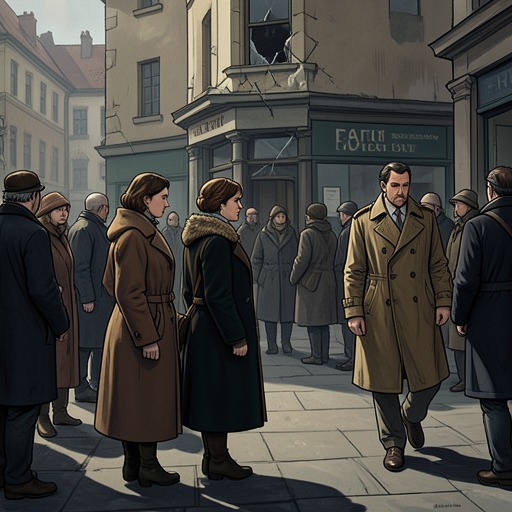
The street is narrow enough for the approaching car to slow as Judah recognizes the ambulance outside Chaim’s building. The location is therefore introduced through movement, interruption, and visual misrecognition rather than through a neutral description. The familiar route to a mentor’s home suddenly becomes a scene of emergency, and the expected greeting gives way to a death that Judah cannot leave behind.
Chaim Lerner’s Death at the Building
When Judah jumps from the taxi, four muscular men are lifting a prone, twisted body onto a stretcher and rushing it into the ambulance. Zehava Lerner and Michal are huddled on the lawn, while roughly a dozen neighbors gather across the street to discover who has required medical attention. Michal recognizes Judah first, runs to him, and tells him that Chaim is dead. She assumes that he must have fallen from the house and asks what he had been doing alone above the ground.
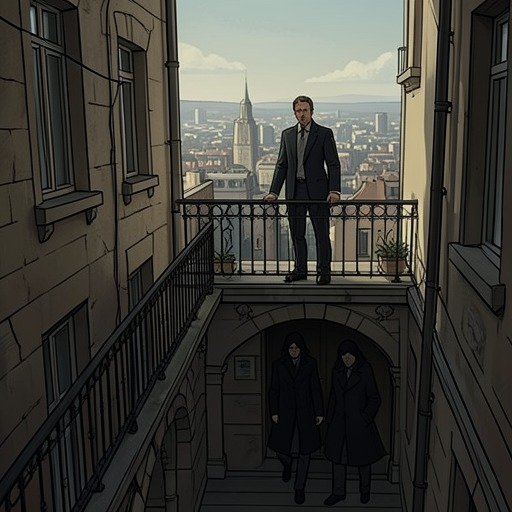
The body is removed from a point directly below the side balcony. That spatial relation initially supports the simplest explanation: Chaim had been on the balcony and had fallen. Yet the apparent clarity of the scene is deceptive. Later investigation establishes that the balcony was seldom used, that its railing rose to about neck height for a medium-sized man, and that Chaim had an injured knee that made climbing over it difficult. The building thus becomes not merely the place of death but a physical problem whose architecture challenges the first account.
The Street as Crime Scene and Evidence
The later inquiry repeatedly returns to the geography around Chaim’s building. Five neighbors hear the body strike the pavement at approximately seven in the evening, a sound compared to a load of flour hitting the ground. They also hear someone say, “Whoops,” in Chaim’s voice, as though he had dropped something. The timing is unusually consistent: every witness places the loud impact at nineteen hundred hours. Michal and Zehava are reported to have been away from the apartment, and witnesses support their absence, initially removing the immediate family from suspicion.
The physical evidence appears to produce competing interpretations. Judah studies the balcony railing and sees four rusting metal bars that would be a serious obstacle but not an absolute impossibility. Hannah, however, examines the railing methodically and concludes that Chaim did not jump, arguing that his injured knee would have prevented him from climbing over it. The disagreement turns Jeremiah Street into a site where memory, bodily limitation, witness testimony, and spatial measurement contest one another.
Michal’s alibi is tied to a receipt from Rafik’s Boutique in the Arab Market of the Old City. She says that she and Zehava were shopping for Michal’s wedding dress at the relevant time, and the receipt records May 5, 1983, at 19:00. The shopkeeper, Rafik Salahmi, had apparently been interviewed by police, while the receipt itself confirms that the two women were purchasing the dress when Chaim died. This documentary record does not explain the fall, but it narrows the field of possible actors and shows how the street’s event is reconstructed through evidence located elsewhere in Jerusalem.
The Balcony and the Hidden Account
The decisive reinterpretation of Jeremiah Street comes much later, when Michal explains what happened on the balcony. Chaim had appeared while Zehava was occupied with a phone call, taken a large drink from a wine bottle, and asked Michal to join him privately so he could apologize for his previous behavior. Once the balcony door closed, he attacked her, embracing and kissing her and touching her breast. When she resisted, he seized her left hand, twisting it badly enough to wrench it from its socket.
Michal then shoved Chaim hard in the chest. He stumbled backward, struck the railing, and for a moment balanced on its top rail. He reached toward her, said, “Whoops,” and toppled over, landing on his head and dying. Her account resolves several details that had seemed disconnected: the words heard by neighbors, the balcony’s dangerous geometry, the body’s position below the building, and the absence of evidence that Chaim had deliberately climbed over the railing. The death was neither a planned suicide nor a conventional murder, but an accidental killing during Michal’s resistance to a sexual assault.
Political and Narrative Significance
Jeremiah Street links private violence to the wider political world surrounding Chaim Lerner. The building is the domestic counterpart to the public conflicts associated with Chaim’s religious-secular reconciliation campaign, Zehava’s prominence as a leading figure in Israel’s political opposition, and the competing ideological communities he hoped to address. Its balcony is a narrow domestic border, but crossing it produces consequences as grave as those attached elsewhere in the book to walls, settlements, refugee camps, and national frontiers.
The street also becomes the point from which Judah’s investigative and literary project expands. His arrival there changes a planned farewell into a commitment to examine Chaim’s mysterious death. Even after he accepts Charlie’s deal and publishes a book that preserves the death as an unresolved mystery, Jeremiah Street remains the suppressed center of the narrative. The public version permits theories of suicide, accident, or conspiracy; the later disclosure restores the concealed sequence of assault, resistance, fall, and death. In that sense, the street embodies the book’s larger concern with how physical places preserve truths that official explanations, family silence, and published narratives can postpone but cannot permanently erase.